online lessons-page2
online lessons
The lessons on this page will give you experiences of great ease and freedom .. They offer a deep immersion into the experience of life within your body and will assist you to understand what is going on within you. They are organised into themes but with each lesson there is a common goal - tuning in to the language of sensation, without correction - in order to refine the ease and quality of the way you sense, think, feel and move.
The lessons are not things that need to be learnt successfully or done properly .. they are opportunities to observe, appreciate and harness the unique qualities and characteristics of your body .. and how it serves you in life ..
Keeping your attention focussed on the lesson, is in itself a meditation that offers a holiday. Slowing down .. so that you move in harmony with the rhythm of your natural breath .. will enable you to luxuriate .. in the sense of who you are, what you are and where you are ..
So take it easy and remember that in this work, less is more! Reduce effort and simplify the way you move. Gently observe the dance of your mind through the whole of your living body .. and the life of where you are ..
A lesson in supine and prone that utilises your weight, the gentle movement of your skeleton and the connective power of touch to align and organise your body.
Explores the relationship between your arms and the rest of your body through both skin and skeleton. It gives a great sense of freedom of movement.
Circles of the heel, head, chest and pelvis along with awareness of how your body moves inside your suit of skin, is the playground for an exploration of connected movement.
An exploration of layered tension, centred movement and the connection of your limbs to your torso. Organises your legs and pelvis to make standing, walking and rolling to sit, easy.
Rolling your heels and the manipulation of your diaphragm and torso, offer a means to experience the strength of your centre and the volume of your body.
Explores the relationship between your hands and feet - how they influence, and are influenced by, the organisation of your head, neck and torso. It gives a great sense of lightness and freedom of the limbs.
The substance of air! We imagine ourselves falling to sense the resistance of air. We swoop & curve over mountain fields like wing suit pilots & explore what is needed to control our flight. We explore the freedom of our head, neck & torso. If we move with our breath & imagine the air both around & within us does it become possible to lift ourselves with less effort? Can you walk on air?
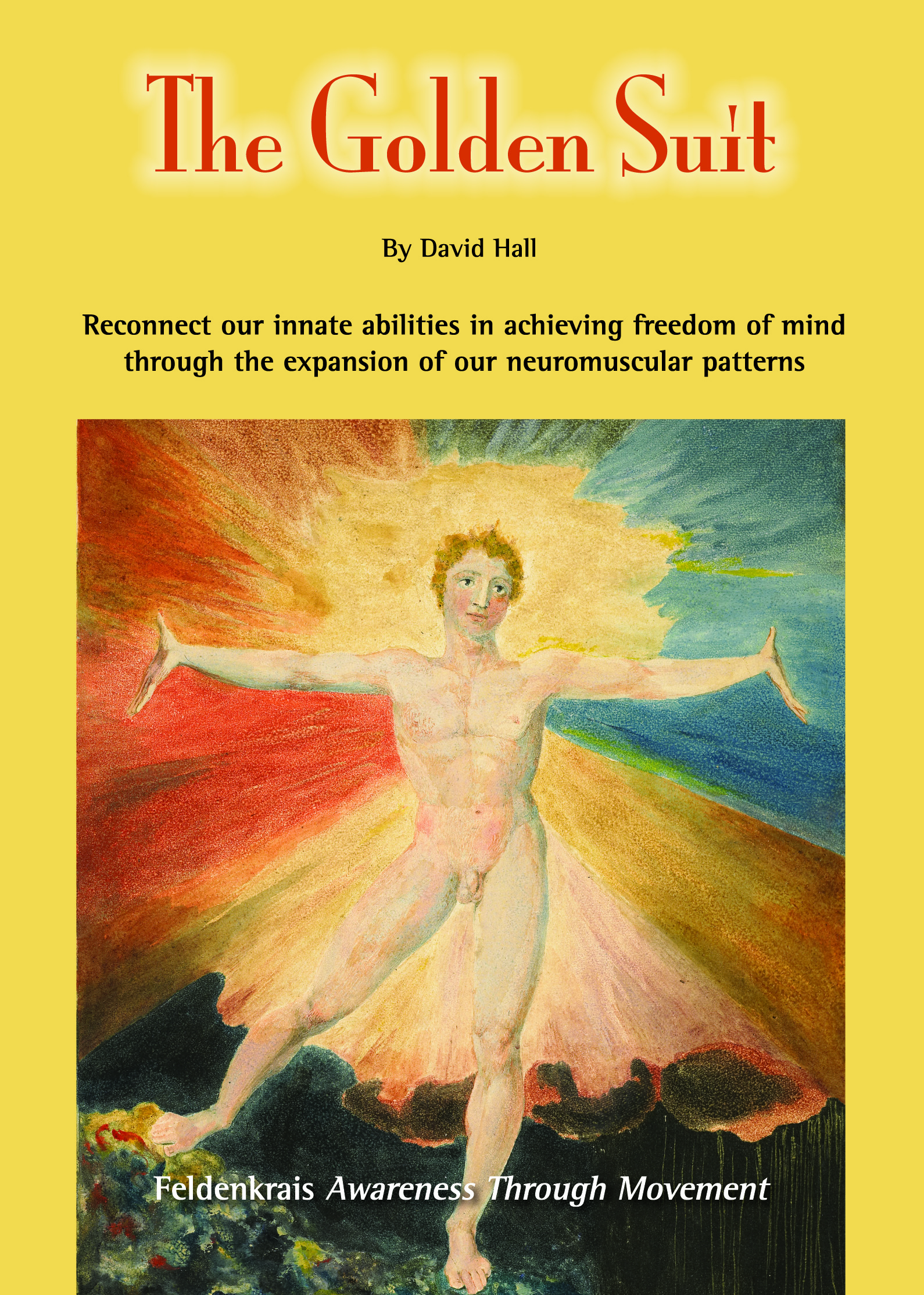
This lesson (recorded live) is an extension of The Golden Suit series. It will give you a sense of the way the layers of tissue within you slide and interact. It leaves you with a lovely sense of integration. The secret is in doing less! In doing less you'll be able to extend your awareness to feel the influence of the movements through your whole body.
How would it feel if you could adjust the skin, muscle and fascia of your body in the same way you adjust a pair of custom made gloves? This live lesson explores the cylindrical experience of life within our bodies. We sense our skeleton moving within our skin and in the process become more comfortable.
This lesson offers an experience of the way your hands connect through to your feet via the head, neck and torso. It will be very useful for anyone who experiences neck, shoulder or arm tension.
This live lesson explores the way you use your feet and legs to move. The connection between the back of the heels and the back of the head through your skeleton and the muscle through the back of your body. It makes it very easy to walk. Make sure you take the time to rest in the second half of this lesson. If you feel the need to stop and rest don’t wait for me to suggest it.
This is a brief lesson of only 22 minutes but it’s extremely useful. It uses the natural breath as teacher. If we bring ourselves to stillness our breathing becomes quiet and effortless. If we can learn to mirror that effortless movement with other parts of our body a great deal of ease and relief become available. Very useful for arthritis or otherwise sore joints.
This live lesson explores the often hidden tensions of our hands and forearms and their connection to restrictions of the head, neck and shoulders. Particularly useful for musicians or anyone else interested in the precise use of their hands.
This lesson improves the image of your arms and hands and their connection through to your pelvis. It creates a deep sense of peace and is an opportunity to minimise tensions through your hands, arms, neck and shoulders.
The sense of where our legs begin and end can make a big difference to way we sit, stand and move. This live lesson gives you the opportunity to tune in deeply to what happens when you move your legs. It will give you a great sense of strength and presence. Go for a walk after doing the lesson!
This live lesson will show you restrictions you never knew you had. Your shoulders, arms and hands are the most differentiated part of your body. Subtle tensions in the wrists and hands influence our dexterity in a significant way. This lesson continues the emphasis on the underside of the shoulder and the inside of the pelvis and torso to achieve a freedom in your hands.
This lesson explores how taste and smell contribute to our sense of the world and how we move through it. The tongue has reciprocal relationships with the gut and with the structures of speech and communication. Often it is engaged in responding to the inner commentary that rabbits on within us. If we move our tongue slowly and consider what we feel, how does this influence both the way we feel and the way we sense our world? Is your world nutritious?
How do we organise ourselves to exert force through our limbs whilst still maintaining the sensitivity to carry out complicated actions with our hands? How do we find the middle of the arm and it’s connection to the rest of our body? This lesson explores our sense of the whole torso, arm and hand from the inside. Very useful for musicians or anyone for whom dexterity is a benefit
This lesson explores how we can exert force with dexterity and how one side of the body influences the other. it is an opportunity to refine our ability to move without bracing ourselves unnecessarily and to understand the value of sensing our bodies in three dimensional space. Very useful for musicians or anyone for whom dexterity and sensitivity of touch are important.
This lesson explores the connection of the limbs to the torso and the way force is channeled through the whole body in even the most subtle actions. It examines how to use the movements of one side of the body to listen to the other. It is an opportunity to feel how the whole hand and foot function when interacting with a surface in your environment. Very useful for musicians and anyone for whom dexterity is important. Also useful for skiers!
This lesson explores the importance of orientation when moving through space. Having a clear sense of where you are heading and of how your whole body is organised within your visual field can make an enormous difference to the way you move and function within your environment.
This lesson explores the the value of maintaining the length and width of your head, neck and torso as you move. We explore a useful image for maintaining the stability of your balance and compare the orientation of each side of our body within your visual field. You’ll feel like you’re floating on air!
This lesson explores how to use the weight of your limbs and the weight of your head, neck & torso to sail through the field of gravity.
Learning to rise up from the floor without effort is something that requires stillness and a willingness to consider your interaction with gravity anew. Attention to where you are and the ability to imagine your trajectory through the visual field enable you to move with ease.
How do we sense and navigate the space around us? What is the sound of movement and the memory of space? How do we listen with our whole body? This lesson explores our orientation within the auditory and visual fields and may alert you to sensory organs you never knew you had.
The movement is from the floor to sitting with our legs splayed to the side but how do we get there and where does the movement take place?
This lesson explores how to develop subtle awareness. It’s done on your back and involves raising and lowering your head or pelvis in a variety of configurations. How do we plan and visualise movement within our sensory fields? How do we use sound and vision to navigate our world? This lesson will leave you feeling centred, deeply relaxed and able to move in an easy conscious manner.
This lesson explores the way we use each side of our torso to counterbalance and in particular examines a way to sense and unravel those parts of ourselves that seem tight no matter what we do. It will leave you feeling effortlessly upright and walking with ease.
This lesson explores the spinal movements of a fish with a vertical tail and a dolphin with a horizontal tail. How can we soften our entire spine so that we can feel like a dolphin slicing through the water with ease or a fish swimming gently in pristine water? We'll explore the involvement of our whole body from the mouth at the top of our head right through to our tail.
I'd recommend a walk or a swim after doing this lesson!
This lesson will give you a sense of freedom in your head, neck & shoulders & a sense of being effortlessly upright. It considers how some fish, over time, developed enough structure in their front fins to move themselves on the land at waters edge, 375 million years ago. That first creature was Tiktaalik. We explore questions of process & consider their experience of life.
Our tongues contain eight pairs of muscles along with both taste and scent receptors. It’s an enormously powerful sensory organ. What is the link between the tongue and our gut? Can we sense our world with taste? We certainly did as infants. Is there still a remnant of that Lizard like ability to navigate our world with our tongue? Could there be a link between gut instinct & the tongue? This lesson will leave you feeling peaceful, free and co-ordinated.
In this lesson we pay close attention to the experience of our tongue and its relationship to thought and feeling. Working with the tongue in this way can distract us from its habitual responses to our inner commentary.
It will leave you feeling deeply peaceful - What is the mystery of speech and what is the role of the tongue? How will it assist us to crawl more efficiently?
This lesson explores one of the fundamental building blocks of our developmental movement sequence. The ability to differentiate each side of our body through awareness of our midline. Understanding the midline is vital to so many functions. It enables us to to maintain balance both within the field of gravity and within our ever changing environment. This lesson will make standing, walking & sensing easy.
Elephants move silently. They lift & place their legs with extraordinary precision. As crawling infants we too learn this skill. How we transfer our weight from four points of contact to three so that the fourth limb is free to move is a vital stage of our development. Returning to this exploration as an adult can make a significant difference to our balance and co-ordination.
This lesson explores the movement of bears to further refine the fundamental basis of the way we move. We examine how each limb functions as an extension of the head, neck and torso and how the other limbs, similarly connected, allow movement in all directions through a floating and grounding web of support. Go for a walk afterwards!
This lesson explores the development of contra-lateral crawling. We examine the capacity to rotate our pelvis and ribcage whilst maintaining a free neck and head and how this relates to streamlined locomotion. We also explore how we use the opposite side of our body to move our limbs and how this translates into grace when walking.
Image by David Clode via UnSplash
This lesson explores the connection of the hands & feet to the head, neck & torso via the four arches of the palms & the three arches of the feet. Sensing the connections of the hand, via the bones of the hand, wrist, arm & shoulder enable us to find strength & balance with a minimum of effort
This lesson continues the exploration of crawling on the hands and feet and examines how we can use the arches of the feet and hands to find the strength and organisation necessary to support our weight. It employs circles of the pelvis, hands and feet to clarify the connection of the limbs into the whole head, neck and torso
This lesson explores branch walking. Walking on your hands and feet when they're in a line requires a contralateral approach to crawling. Allowing the whole head, neck and torso to move as you transfer your weight makes it so much easier. You may even go flying through the trees!
This lesson explores the connection of the legs and torso through the pelvis. How do the legs connect through the bottom of the pelvis? How does the torso connect through the top? We manipulate the space inside the torso using the diaphragm and breath. We also use movements of the legs and pelvic floor. Go for a walk afterwards, it doesn’t just make it easier to squat!
Learning to be comfortable sitting on the floor is one of the best things you can do for long term health and fitness. Many in our chair centric culture find it difficult. They may feel uncomfortable in their back or neck but often it has a lot to do with tensions in the legs. How can we soften in our body so sitting becomes easy? Perhaps if we consider our legs from a different perspective? or the pelvis and how it is central to organising ourselves? or perhaps our gaze? We may find an easy way.
This lesson explores the roundness of our limbs and the way they work together. Our movement is a symphony of arcs and spirals. We function best when we allow ourselves to lengthen and widen and flow with the curves of our structure. Challenging areas of our body are often reduced to two dimensions in our awareness and this is often exaggerated when we are under stress. When stretching we often focus on the resistance points and push in straight lines. This lesson takes place on your back and on one knee and foot. It will be useful to have a cushion for the standing knee!
This lesson explores the way force can be channelled through the torso and limbs if we allow our limbs and torso to adjust as we move. A flexible axis in action. We explore movements from the centre out and from the extremities in. The test movement is spiralling up and down from the floor. Go for a walk afterwards!
How do the limbs connect through the torso? How do they support each other? How do we develop the strength to move in all directions? This lesson explores the cylindrical nature of our head, neck and torso and the way the limbs leverage that shape to facilitate effortless movement.
This lesson explores the shape of our upper body. The twist and roll of reaching it allows. We consider our limbs as having the precision, strength and delicacy of a flower that can both open or close to display or protect it’s essence. You’ll need a rolled up towel, a book as thick as the rolled towel and two pillows to place behind your knees. You may want to walk afterwards. It’s the loveliest feeling.
This lesson explores the complex rhythms of everyday movement. The length of a particular body segment determines the speed it will move in a specific time. Our bodies are made up of segments of so may lengths! Moving everything together is a matter of listening for harmony. Stillness and the breath are useful allies in this journey.
This lesson explores a way to make our legs and pelvis light. We use circles of the front & back of the feet, hands and head in a various positions to improve the organisation of our limbs and torso. The lesson finishes by rolling into a shoulder stand. Can you roll yourself leading from the head or the feet? Can you maintain the length and width of your body as you do it. Can you dance with the clouds? Unfold yourself with the grace and beauty of air.
This lesson explores how circular movements of our head, legs and pelvis can be used to create strength and connection through your limbs and torso. We use rolling up to sit as a test movement and consider the incredible loop of our cardiovascular system and the circular nature of our breathing to make it easy.
This lesson explores a way of connecting ourselves into a rounded shape that enables us to roll in a circle whilst holding our feet. We explore circles to feel the front, back and sides of our head, neck, torso and limbs. Take your time with this one! Never use force! If you can't do any part of the lesson just adapt it to what you can do or just do it in your imagination. You will still get the benefit. If you try it later on you may find it becomes easier.
This lesson explores the continuity of the head, neck, torso and limbs. We ultimately find a way of rolling up to stand that never fails to surprise onlookers if performed without fuss. That being said, it's very important that you take your time. The other lessons in this series are a necessary preparation if you haven’t done a forward or backward roll. Never use force if you can't do a movement and don’t do this one if your back or neck is sore!
Explores the ability to sense the structure and organization of your body with your hands. You focus on both the sensations and memory of touch as you consider your alignment in sitting and standing.